Belonging
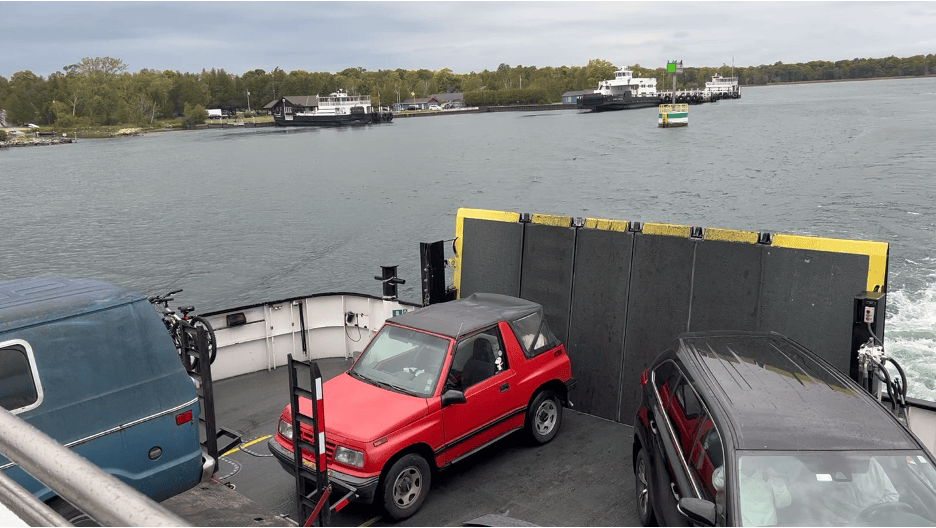
It’s not easy to get there because you have to go across Death’s Door. It’s in the middle of the United States, where Lake Michigan waters mingle with those of Green Bay. Winds can get high, and the ferry will stop running for a day.
I was lucky; after a long wait in line, the ferry whisked me safely across to Washington Island in 20 minutes. I stayed there for three days to hear from five writers from various backgrounds
This year’s festival theme was belonging. The moderator, Libby Sachs, asked us all to arrange ourselves from those who thought they’d started out belonging to those who felt they didn’t belong. I felt I didn’t belong as a child. I was the only girl, the only redhead, and I wanted to work with my Dad in the shop but was told girls didn’t do that. So, I’d sit in the weeds with bolts and nuts, trying to put them together. I wanted to bring them into the house, but that wasn’t allowed either. Then, Dad died; Mother really preferred the boys, especially Dennis, my older brother. My younger brother, Gene, and I were just naughty brats.
Another woman on the Island, Emily, was even a bit further down the table into the corner of unbelonging than I was . A lot of people were in the middle, and some were born belonging.
We went back and sat at our tables. Each table was to discuss the question: “Is belonging something you receive, something you make, or something you perform. Most came to the decision that belonging was fluid. You receive it as a child, then things change, and it becomes what you make of it. One person said you take it. No one liked the idea of performing belonging; that seemed fake.
My take on belonging was that you garden it. You get planted and nourish yourself and those around you. We took a break and then returned for a poetry reading. A middle-aged man who teaches English had written this poem for the workshop:
Here are the first two stanzas of his rhyming poem. It spoke to me in this current chaotic time.. .
You’ve lived a time when neighbor wouldn’t thieve
From neighbor: Firewood or building stones by night;
By plainest day, election signs as spite,
Revenge. As threat. You’ve lived a time to grieve.
For hacked jackpines, to mourn for former shore
Overlapped to silted shoals by brazen waves:
Your world betrayed, where thoughtless gall outbraves
Sense. But how to live? – not just through but for,
We were done for the day. I got Emily’s number, and we talked about having dinner together, but then she called and said, “No, she just wanted to be alone and write; maybe stop at the restaurant bar to eat.” I said, ”No worries”, but that wasn’t really honest. I hate eating alone in a restaurant. I find it very upsetting, and I certainly won’t go to a bar. I went for a walk, stopped in the grocery store, and got a little more food. I had stuff for a cold dinner in my motel room. I planned to go out for breakfast somewhere by myself or perhaps call Lynn and Jim people I met last year. I needed some down time too.
Day 2
Workshops
Day 2 of the Washington Island Literary Festival. I woke up early, then went back to sleep. Slept 9 hours, woke up again, and had a short talk with my husband in Australia. It was his evening while I was experiencing morning. I made lunch to bring with me, then went to my first workshop, Writing 101 with Libby Sachs and Alessandra Simmons Rolffs. It was about seeing, not writing clich[MS4] és. Alessandra was a poet and emphasized expressive words. We were given an assignment to write an up-close description of something. I chose to write about garlic hanging to dry:
Blocking the view
of trees beyond
No, not strings,
Garlic green part
Turned brown
Hung upside down.
Dried life
Itself preserving.
Pulled from the ground
Each clove potential
For new life
Not good; It still needs more detail. I will work on seeing more detail and using more precise words.
There was a poetry reading during lunch. I brought my sandwich, but it was too cold to eat, so I went back to my motel room and tried to write about my Me ID experience, but it just seemed stupid. I decided to read from Fred, my children’s book for the open mic tonight.
I went to an afternoon workshop. I started walking, but some people offered me a ride, so I took it. If I’d walked, I probably would have arrived late. The workshop focused on setting and how it can reveal something about a character. Naeem Murr, a Palestinian who grew up in London, led it. He works and writes at a college and had some stories he wanted us to read before class, but we didn’t get them in time. He is going to email them to us. I did a writing I may use somewhere in the novel I’m writing, Alice Goes Back Down Under, about Alice coming home to her house.
She walked past the rock garden just beginning to burst into pinks and purple spring flowers and ascended the curved steps to the door. When she opened the door, she was hit by the smell of jasmine incense.
Oh, yes, it was Samantha & Charlie – she’d left them in charge when she went to Australia. It wasn’t the home she and Rupert had shared. Now it was Samantha and Charlie renting her home. Could she fit in again? She longed to be back in Australia.
Actually, I’ve skipped all this in the novel I’m writing and got right to some action, so will have to find a place for it.
We went home for a break and then got back together for light snacks. They even had gluten free crackers and cheese. I volunteered to read during open Mic. I read the first chapter and a half from Frederick G. Pig. They laughed. Many of the readings were very serious reflections on responses to the current political situation. One very moving one was for the death of Petty in Minneapolis, and the authors feelings while playing a piano.
DaY 3
Author Talks
Last day of the Washington Island Literary Conference. It was morning coffee and then a panel discussion on belonging followed by talks from the individual authors who had given the workshops.
The sky was overcast, but it wasn’t raining. Coffee, tea, and breakfast muffins were served outside. They even had very good gluten-free blueberry muffins. As someone with wheat allergies, it made me feel like I belonged. I had eaten an egg before I left the motel room to make sure I had protein.
At 8:45 we went into the True Blood Performing Arts Theater. 5 chairs were arranged in a line across the curved stage. A red curtain hung behind the chairs and a podium was to the left of the stage. Catherine Jagoe on the far left was a tall and lanky poet with thin blond hair who writes soul to soul. Next to her was another poet, Erika Meitner, who described herself as an extrovert and writes about her Jewish family. The middle chair was a younger-looking woman with dark hair pulled back from an oval face. Anika Fajardo, born in Columbia but brought up in Minnesota. Next was the only male, Naeem Murr, a Christian-raised Palestinian who wrote a novel about a Palestinian living in Chicago. On the far right was another woman with wispy blond hair, Jane Hamilton, a well-known Wisconsin author. They discussed the theme: Belonging
The narrator explained that each year the conference has a theme. Sometimes there is a big discussion about which theme, but this year everyone on the planning committee agreed on belonging.
Ericka explained that it doesn’t mean conforming. [ It was more like the Muppets, all relatable. Each being different from one another, which helps us all learn empathy.
After the group discussion, they went on to talk about the theme and their own books in more detail.
Catherine Jagoe wrote a book, Unbelonging: A Life in Search of Home. She describes herself as a child of Empire. Born in Malaysia of Irish parents. Dad was in the civil service in Nigeria in the 1950’s. Her mother was born in India. She went to boarding school in England. Moved 23 times in England and then was in Cairo. She now lives in Spain, England and the USA. She asked, Where on earth do I belong? And then looked at the etymology of the word belong in English. One might think is means being somewhere for a long time, but it doesn’t. Be is an intensifier it is not from the verb to be. Long is to be a property of. She defined the terms Kith & kin. Kin are blood relatives, but Kith is from couth (known) and includes all known neighbors and acquaintances.
Naem Murr spoke on his book Every Exit Brings You Home. His family escaped Palestine yet the occupation of Chicago by ICE brings back memories. He grew up in London his mother was Irish, but his childhood was in Lebanon. His relatives tell him You’re English now – don’t look back but he has survivor’s guilt, which is what his novel is about. He feels any moment of intimacy brings one to the sacred and profane.
Anika Fajardo spoke of being born in Colombia but had no memory of it. Her mother took her back to Minnesota, and she grew up there. She had no contact with her father until she wrote to him as a teenager. At 21, she went to meet him. She wrote a memoir Magical Realism for Non-Believers A Memoir of Finding Family. And recently published a novel on the same theme, The Many Mothers of Dolores Moore. Having written a memoir and now writing a fiction story, I had to buy both, and I’m now reading them.
Erica Meitner read some of her poems. Personal narrative poetry. The one I liked best was about Yellowstone, with beautiful descriptions of the pools, and then the torons. A toron is a combination of moron and tourist.
Jane Hamilton had everyone is stitches with her narration of a neighborhood in the 1950’s teeming with children. She has 8 published novels, the most recent being A Map of the World. Before she got that published, she almost gave up on writing ; nothing was being accepted. She loved Willa Cather, who said the purpose of writing was to recall youth and bring the reader joy. She told a lovely story about being at a charging station with her electric car when someone told her she looked like Jane Hamilton. When she laughed the man explained that he had read all of her novels. Then his wife explained they were taking them with her so he could read them while he was in Chemo. They hugged. Such a lovely story.
The next day I got on the early Ferry to go back to the mainland. I was hoping to see some other people from the conference on the boat. It was windy, with gusts of autumn air. Most people stayed in their cars. I put on my winter coat and climbed the steep metal stairs to the top viewing deck. I noticed a familiar woman staring out at the blue Lake Michigan waves. I turned in her direction and asked, “Were you at the conference?”
She said, “Yes, I was”. She recognized me from open mic and said how much she liked my reading. We discussed Guinea Pigs and what good pets they made. We talked about family and raising children.
Then I asked, “Did you like the conference?” She said, “Yes, but I’m rather tired because I was one of the presenters.”
I looked at her again, knowing I should recognize her, but the hood from her coat covered half her face. I gave up and asked, “Who are you?”
“I’m Jane Hamilton,” she said.
I laughed; it was almost the story she’d told at the conference. We talked a bit more, then it was time to get in our cars and drive off our separate ways.

